
Saturday, 6 April 2013

Friday, 5 April 2013
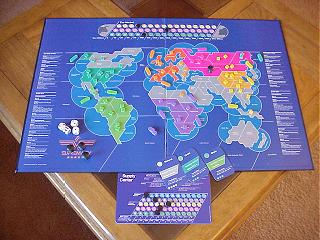
Supremacy: The Game of the Superpowers
Supremacy: The Game of the
Superpowers is a political, economical and military strategic board wargame
published in 1984 by Supremacy Games and design by Robert J. Simpson. Supremacy
pits conventional superpowers against each other for control of the earth
similar to a modern warfare Risk with an integrated supply and demand economic
system. Warfare comes in multiple forms of conventional, biological, chemical
and nuclear. (Supremacy: The Game of the Superpowers) The players
represent the superpowers of the world; the United States, the Soviet Union,
the League of European Nations, the People's Republic of China, the Confederacy
of South America and the Federation of African States. The goal is to conquer
the world either through military or economic strength. Players can build army
and naval units and to do so requires resources. There are three types of
resources in the game; oil, wheat and minerals. Once the units are built they
require a continual input of resources in the form of maintenance. Armies
require grain to move and navies require oil. In addition, salaries must be
paid for each army and naval unit. Each country on the board is capable of
producing certain types of resources. Players can gain access to those
resources by capturing the country in question and playing the appropriate
resource card. Alternatively, players can buy or sell resources on the global
market. The game also spawned a great number of supplements to
expand the game further. (Supremacy: The Game of the
Superpowers)

Nuclear War
Nuclear War is a multiplayer card
game designed by Douglas Malewicki and originally published in 1965. It is a satirical
game in which each player represents a ‘major world power’ and attempts to gain
global domination or annihilation through the strategic use of propaganda or
nuclear weapons. (Nuclear War) If you choose do,
players can choose to use one of the joke countries that come with the game or
you could choose an existing country. Each country has its own traits for
example Bagmad, the terrorist state, can send 10 and 20 megaton bombs up the
track to attack enemies without inciting nuclear war. Bananaland, also known as
Cuba, can give population to opponents to make them lose turns. Players can use
propaganda cards to destroy thier enemies. If you wipe out your enemy through
propaganda their game will end, however, if they are wiped out through secrets
or bombs they get what's called a final retaliation. That is the equivalent of pressing
a self-destruct button and attempting to destroy everyone. (Gronli, 2009) The game and its multiple
expansions have won multiple awards such as the Charles Roberts Award for Best
Science Fiction Boardgame of 1983 (List of Winners) and has been inducted
into the Origins Adventure Gaming Hall of Fame.


Axis & Allies
Axis
& Allies is a series of World War 2 strategy board games created by game
designer Larry Harris Jr. and published by Nova Game Designs in 1981 and
reprinted in 1984 by the Milton Bradley Company. It is intended to be played by
two to five players over the age of twelve with games lasting anywhere between
and around two to ten hours. The game is incredibly popular within the board
gaming community printing two million copies since its release. Players play as
members of the Axis – Japan and Germany - or Allies – UK, US and Soviet Union –
with the Axis players teaming up against the Allied powers in an attempt to
conquer key territories represented by regions on the board. This was done in
earlier models by capturing and holding certain territories until the end of a
round after each player has moved according to a specific order. (General M.
Bradley, 1991) Players have at their disposal
infantry, armour, fighters, bombers, battleships, aircraft carriers,
submarines, troop transports, anti-air guns, and factories. All of the units
perform differently and many have special functions. Players have to work
together with their team mates in order to coordinate offences and decide how best to utilize their production points. (Axis &
Allies)


Warhammer 40,000
Warhammer 40,000 or informally named Warhammer 40K is a tabletop wargame played using miniature figurines first designed by Rick Priestley and produced by Games Workshop in 1987 as Warhammer 40,000: Rogue Trader – which is considered to be the best of collection because of its diverse universe and free-form rules.


Stratego
Stratego is a strategy board game
to be played by two players with fairly simplistic rules. Trademarked in 1947
by Dutchman Jacques Johan Mogendorff and originally manufactured distributed by
Jumbo, the Milton Bradley Company bought the rights to it and distributed it
across America to commercial success leading to future releases of licensed
variants of the game. However the original idea for the game was patented by a
French women named M. Hermance Eden in 1908 as ‘jue de bataille avec pieces
mobiles sur damier’ which translates to ‘ a battle game with mobile pieces on a
game board’. The game soon sold as L’Attaque is generally considered an ancestor
and the inspiration for Stratego and was very popular all over Europe especially
throughout World War 2 due to the common theme of war that engulfed this during
this period. Although first advertised and catered towards an adult audience,
Stratego quickly became a family favourite and today has amassed a large fan base
reaching across the world and has even been adapted to be played as a computer
game and over the internet. (History) The objective of the
game is to find and capture the opponents flag or capture so many enemy pieces
they are unable to move, this is achieved through players landing on their enemies
pieces and both player’s piece subsequently being revealed with the weaker of
the two pieces being removed from the board.


Dungeon and Dragons
Dungeons and Dragons is a fantasy, role-playing game originally
designed by Gary Gygax and Dave Arneson and first published in 1974. (Dungeons and
Dragons FAQ)
Dungeons and Dragons derived from wargames but departs from traditional
wargaming assigning each player a specific character rather than an army or
group of units. It is widely considered as the beginning of modern role-playing
games and amassed a fan base of 3.5 million players around the world 7 years
after release and a total of twenty million players in total overall. It is the
most widely recognised and played role-playing game and has been sold is 50
countries and translated into a dozen languages and has released multiple
editions over the course of the last 39 years. The game focuses on players
grouping together and creating ‘parties’
of adventurers, during the course of the game each player directs the
actions of their character and their interactions with other characters which
is performed via verbal impersonations of their characters. The rules and
events of the game are depicted by the Dungeon Master who selects various NPCs
, party encounters and the settings in which these events occur with the
outcome of these encounters based upon the player’s choices and actions. Each individual
character has multiple different attributes that are determined at the beginning
of the game by each player with more recent versions of the game determining
the attribute values using a points system.


Fletcher Pratt's Naval War Game
Fletcher Pratt’s Naval War Game was created by Fletcher
Pratt and published by Lake Shore Press in 1943. It is widely considered one of
the most popular and successful war games of the 20th century and was
even played across entire ballroom floors during its peak in popularity and
could be played by as many as sixty people. Traditionally each player would
command a single wooden ship – sometimes two – controlling the movement and
firing of the vessel with the aim of the game to sink all other ships. Players must focus on three main factors: the
movement of their ship, calculating the range to fire at your target and
applying any damage received from hits the enemies have scored on the player. Maneuvers were calculated via a complex mathematical formula and each ship has
different capabilities and attributes based on those of real life ships, for
example if one ship has a higher top speed than another it can move more
fractions of an inch per round. (McAleer, 2012)


War Re-enactment
War re-enactments are a type of war gaming that is physically acted out traditionally using a large group of people re-enacting a famous battle, they are particularly popular in the United States. War re-enactments range and span through different time periods, things more recent such as the American Civil War and World War re-enactments are the most popular, but other re-enactments such as Classical Re-enactments portray the Greco-Roman world. The earliest recorded activity relating to a re-enactment was the recreation of famous battles staged by the Romans within their amphitheatres as a form of public spectacle. Many people pursue war re-enacting as a hobby with the age ranges being incredibly diverse with people of all ages attending events. A lot of people are interested in getting a historical perspective of such events; other participants participate for the escapism that the events offer. Living History is a form of war re-enactment that is meant solely for the purpose of education to the public, they do not always entail a mock battle instead some aim at simply portraying what a soldier’s life was like during the period in which the re-enactment is set. Closed events known as Tactical battles, which are not usually open to the public, are fought like real battles with each side devising strategies and tactics used to defeat their opponents, these traditionally are not recreations of battles and are played competitively. Total immersion events are ‘hard-core’ events that are re-enacted with a higher sense of realism, often featuring extended marches and generally living like an actual soldier to make it feel more authentic.


Thursday, 4 April 2013
Risk
Risk is a popular strategic board
game that offered a new dynamic take on board games that revolutionized the
industry and is considered a classic. It was invented by French film director
Albert Lamorisse and released in 1957 as La Conquête du Monde or The Conquest
of the World in English. (Risk: The Game Of Strategic
Conquest)
It is a turn-based game to be played by two to six players with the primary
objective of the game being to ‘occupy every territory on the board and in so
doing, eliminate all other players.’ (Parker Brothers, 1963) Players control
armies that they use in an attempt to capture enemy territories with the
results dependent on dice rolls. Risk is widely known throughout the world and
became incredibly popular in France, America and Italy to the point where there
have been multiple licensed variations of it including Risk: Star Wars Original
Trilogy Edition and released multiple video game adaptions. (How to Win at
Risk)

Little Wars
Little Wars is a set of rules
used when playing with toy soldiers written by H.G. Wells in 1913. (Belli, 2013) The book was not
only a set of rules, it was also ‘an important socio-political work’ (Silvano, 2005) that hints at a few philosophical
aspects of war and Well’s belief in pacifism. The book was written in a playful
style and illustrated with amusing drawings and photographs offering an insight
at the author’s personality. (Little Wars) Little Wars included
simple rules for infantry, cavalry and artillery in the form of a 4.7 inch
naval gun that launched projectiles commonly in the form of wooden dowels used
to knock down enemy soldiers. The development of the game started via a visit
by his friend Jerome K. Jerome after he visited, after dinner Jerome began
shooting down toy soldiers with a toy cannon which inspired Wells to write
Little Wars.

Diplomacy and Gaming-By-Mail
Diplomacy is a strategic board
game created by Allan B. Calhamer in 1954 and released commercially in 1959. (Calhamer) It was a wargame
focusing on negation and diplomacy, hence the name, with absence of a die or
form of randomizer requiring the players to use skill as a means of winning the
game. (Parlett, 1999) Diplomacy was the first commercially published
game to be played by mail, a form of gaming played through postal mail – in
this scenario - or email, popularized in the 1960s and reaching its peak in the
1980s. Diplomacy differs from the majority of war games in multiple ways
including players write down all their moves in secret after a negotiation
period and once revealed are put into play simultaneously; social interactions
are an essential part of the game. It is played with between two and seven
players and comprises of a negotiation phase and a movement phase. In the
negotiation phase players may use any verbal means possible to forge alliances
or form arrangements with one another, communication is a valuable asset to
have during this phase. The movement phase consists of players writing down
orders for each of their units in secret, once each player has done so each
order will be executed simultaneously. Players must capture each other players
supply centres, the winner is declared once each of the other players have been
eliminated via lack of supply centres or if one player has over half the supply
centres on the board. (Avalon Hill Games, 2000) It was inducted into
the Academy of Adventure Gaming Arts and Design Hall of Fame in 1994.

Sunday, 20 January 2013

Sunday, 21 October 2012
Essay Choice - Surrealism


 I've decided to use Surrealism as my design movement for my essay due to it appealing to me. The fact that the whole design movement centres around the impossible seems appropriate because in a game anythings possible. The paintings created by various artists including Salvador Dali and the German painter Max Ernst appeal to me more than the traditional artwork of more famous artists such as Edvard Munch and Pablo Picasso because I personally find them more visually appealing this is possibly due to myself being born into more modern and colourful world visually when it comes to artwork. Computers were revolutionizing the way people lived and worked as I was growing up, a new medium was born that was available to artists to create new modern pieces of digital work. Digitally created graphics and artwork tends to be colourful and non sequitur much like Surrealism so I believe finding common ground between both is the reason I much prefer the artwork of Surrealism over much more celebrated works from alternate movements. Surrealism isn't exclusive to the visual arts, literature features heavily in surrealism, and theatre, film and music do also but in a lower capacity, but my preference is the visual arts aspect of it
Saturday, 20 October 2012
Surrealism
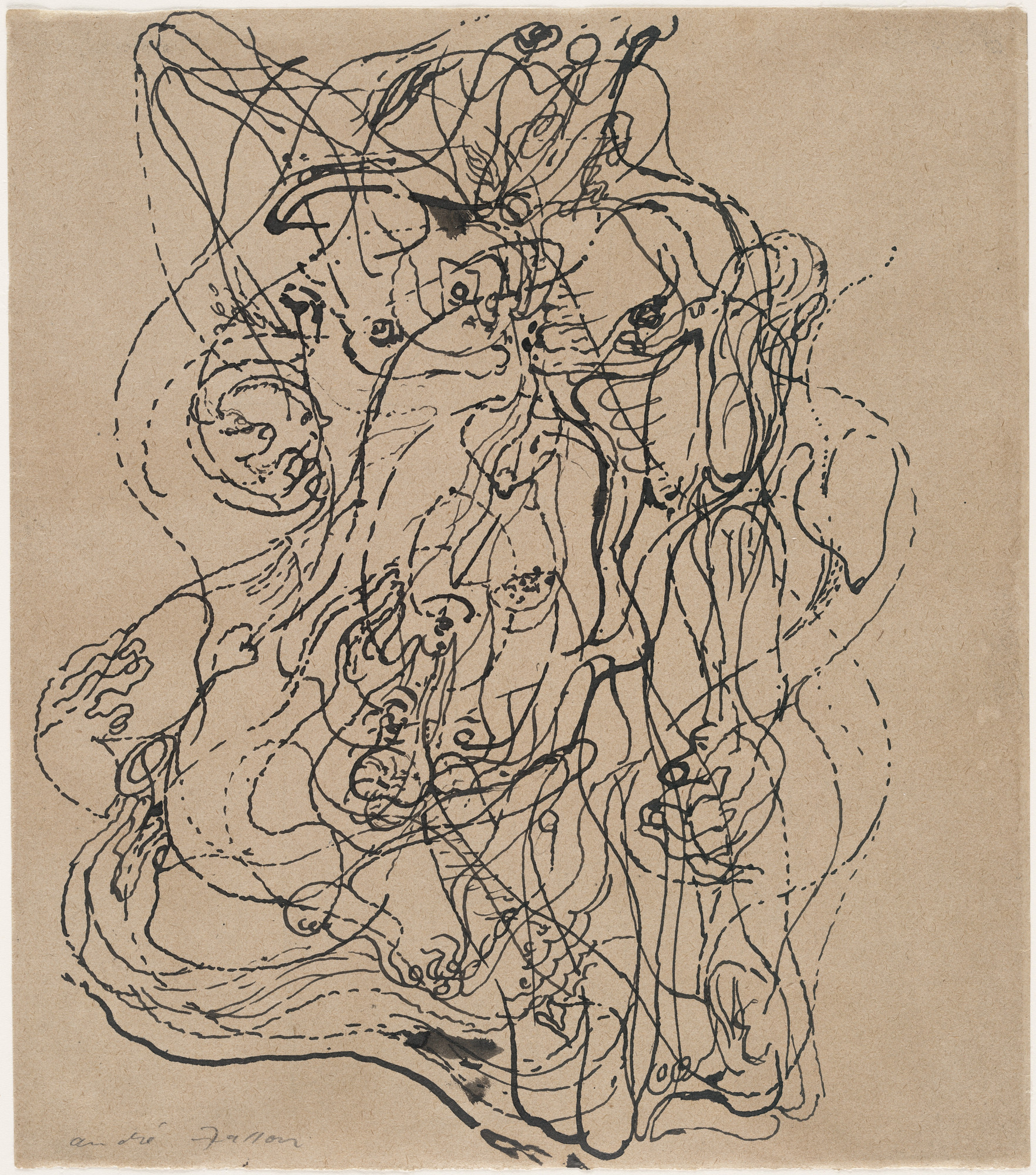 Surrealism is a cultural movement that began in the early 1920s, and is best known for its visual artworks and writings. It developed out of the Dada activities during World War I and the most important center of the movement was Paris. From the 1920s onward, the movement spread around the globe, eventually affecting the visual arts, literature, film, and music, as well as political thought and practice, philosophy, and social theory. The movement in the mid-1920s was characterized by meetings in cafes where the Surrealists played collaborative drawing games, discussed the theories of Surrealism, and developed a variety of techniques such as automatic drawing. Automatic drawing was developed as a means of expressing the subconscious. In automatic drawing, the hand is allowed to move randomly across the paper without any planning or thought being applied beforehand.
 World War II created havoc not only for the general population of Europe but especially for the European artists and writers that opposed Fascism, and Nazism. Many important artists fled to North America, and relative safety in the United States. The art community in New York City in particular was already grappling with Surrealist ideas and several artists like Arshile Gorky, Jackson Pollock, Robert Motherwell, and Roberto Matta, converged closely with the surrealist artists themselves. During the 1940s Surrealism's influence was also felt in England and America. Mark Rothko took an interest in biomorphic figures, and in England Henry Moore, Lucian Freud, Francis Bacon and Paul Nash used or experimented with Surrealist techniques. However, Conroy Maddox, one of the first British Surrealists whose work in this genre dated from 1935, remained within the movement, and organized an exhibition of current Surrealist work in 1978 in response to an earlier show which infuriated him because it did not properly represent Surrealism. Maddox's exhibition, titled Surrealism Unlimited, was held in Paris and attracted international attention.
There is no clear consensus about the end, or if there was an end, to the Surrealist movement. Some art historians suggest that World War II effectively disbanded the movement. However, art historian Sarane Alexandrian (1970) states, "the death of André Breton in 1966 marked the end of Surrealism as an organized movement."
Sunday, 14 October 2012


Sunday, 7 October 2012
Modernism
 Modernism the term, tends to describes the modernist movement in the arts, originally arising from wide-scale and far-reaching changes to Western society in the late 19th and early 20th centuries. In particular the development of modern industrial societies and the rapid growth of cities, followed then by the horror of World War I, were among the factors that shaped Modernism. Many modernists believed that by rejecting tradition they could discover radically new ways of making art. Arguably the most paradigmatic motive of modernism is the rejection of the obsolescence of tradition and its reprise, incorporation, rewriting, recapitulation, revision and parody in new forms.
 By 1930, Modernism had entered popular culture and The New Yorker magazine began publishing new and modern ideas by young writers and humorists like Dorothy Parker, Robert Benchley, E. B. White, S. J. Perelman, and James Thurber, among others. Modern ideas in art appeared in commercials and logos, the famous London Underground logo, designed by Edward Johnston in 1919, being an early example of the need for clear, easily recognizable and memorable visual symbols.
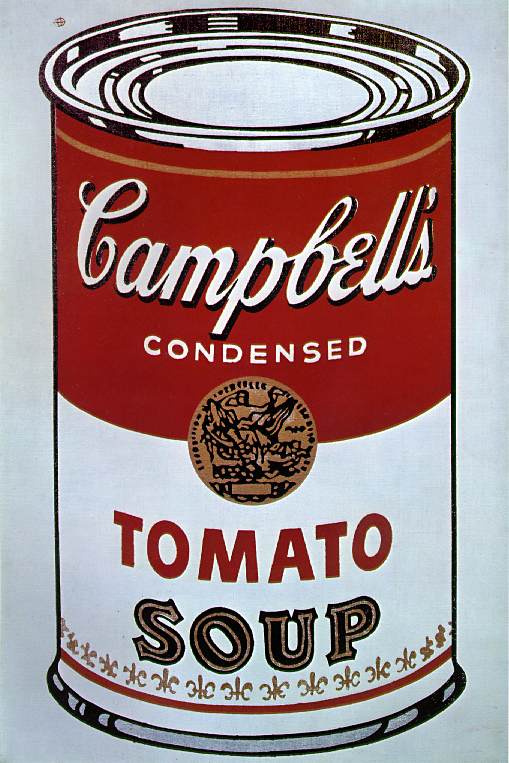 In abstract painting during the 1950s and 1960s several new directions like hard-edge painting and other forms of geometric abstraction began to appear in artist studios and in radical avant-garde circles as a reaction against the subjectivism of abstract expressionism. Pop Art is derived from Modernism and is possibly the most famous variation of it in visual art terms. The most famous Pop Art artists being Roy Lichtenstein and Andy Warhol and their works such as Campbell Soup Cans and Whaam!.
Dada
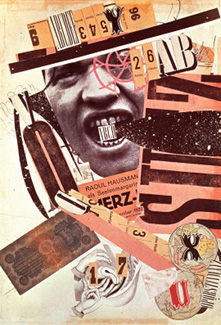
Dada was an art movement in the early twentieth century. It began in Zurich, Switzerland in 1916, spreading to Berlin shortly after. Dada is quoted to have been 'born out of negative reaction to the horrors of World War 1'. The movement primarily involved visual arts, literature, poetry, art manifestoes, art theory, theatre, and graphic design, and concentrated on anti-war politics. Dada was not confined to the visual and literary arts; its influence reached into sound and music. Kurt Schwitters developed what he called sound poems, while Francis Picabia and Georges Ribemont-Dessaignes composed Dada music performed at the Festival Dada in Paris.
 One of the most famous artists associated with the Dada art movement is French artist Marcel Duchamp. Considered by some to be one of the most important artists of the 20th century, Duchamp's output influenced the development of post-World War I Western art. The dadaists imitated the techniques developed during the cubist movement through the pasting of cut pieces of paper items, but extended their art to encompass items such as transportation tickets, maps, plastic wrappers, etc. to portray aspects of life, rather than representing objects viewed as still life. Photomontages were also a popular form of Dada art, using scissors and glue rather than paintbrushes and paints to express their views of modern life through images presented by the media.
While broad, the movement was unstable. By 1924 in Paris, Dada was melding into surrealism, and artists had gone on to other ideas and movements, including surrealism, social realism and other forms of modernism. Some theorists argue that Dada was actually the beginning of postmodern art.
Art Deco
 Art deco is a design movement that rose to prominence in the mid 1930's but actually started a decade prior in Paris. Art deco is most commonly recognized for its architecture and interior design, but also had influences in industrial design, fashion and jewelry, as well as visual arts such as painting, film and graphics design. It embraced influences from many different styles of the early twentieth century, including neoclassical, constructivism, cubism, modernism and futurism, many art deco works drew inspiration from ancient Eqyptian and Aztec forms. It is based on mathematical geometric shapes but other popular themes include trapezoidal, zigzagged and jumbled shapes.
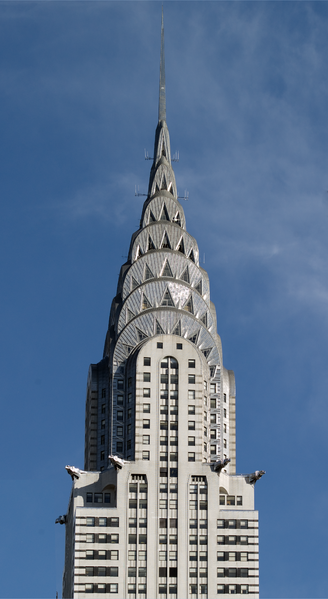 One of the most famous and earliest examples of art deco architecture is the Chrysler Building in New York, the Empire State building is also a good example. New York, Chicago, and Detroit have many surviving art deco buildings. An example closer to home is the former Daily Express building in Manchester built midway through the 1930's.
During the summer of 1969, the popular art historian Bevis Hillier conceived organizing an exhibition named Art Deco at the Minneapolis Institute of Arts which then took place in 1971. Interest in art deco increased further with the publication of his book a year later - The World of Art Deco, a record of the exhibition.
Art deco slowly lost patronage in the West after becoming mass-produced, when it began to be derided as gaudy and presenting a false image of luxury. A resurgence of interest in art deco began during the 1960's, and then again during the 1980's with the graphic design. Its association with "film noir" and 1930's glamour resulted in its use for advertisements for jewelry, fashion and toiletries even today.
Subscribe to:
Posts (Atom)